“Those who demand a “biblical theology” are most often not as close to biblical teaching as is ecclesiastical orthodoxy with its extrabiblical terminology. This is also true for Christian doctrines other than the Trinity(Bavinck, 2011).”
Key Takeaways
– Scripture is the highest authority, with other authorities properly ordered beneath it
– Creeds are essential to maintaining Christian orthodoxy
– Denying creedal authority severs the connection to the historic Church, hindering a true understanding of doctrine
The Irony of the Battle Cry
Despite their historic acceptance, modern audiences widely ignore and harshly judge creeds and catechisms. The common battle cry, “There is no creed but the Bible!” reflects this sentiment. People use this statement as a defense mechanism against what they perceive as threats to Scripture’s authority. While we can find a genuine concern here, this expression demonstrates woeful ignorance and reveals its users’ truncated understanding of the relationship between tradition and Scripture.
First, “no creed but the Bible” is a creed. The opposing party merely stated their beliefs concerning a topic here, which is all a creed is. A creed is a concise response that answers what you believe and why. The only difference here is that this creed lacks historical precedent, subject to change, and is informal. Second, “no creed but the Bible” is a skewed understanding of the link between tradition and scripture that restricts theological study unlawfully.
As Herman Bavinck expressed, “Christian theological reflection on Scripture has every right to move freely beyond the exact language of Scripture to draw warranted inferences from it. These too are authoritative .In fact, theological reflection on Scripture is not even possible without the freedom to use extrabiblical terminology.” Moreover, Bavinck directly addresses modern suspicion by stating that creeds are “not designed to introduce new—extrabiblical or antibiblical—dogmas but, on the contrary, to defend the truth of Scripture against all heresy.”1
Authority Hierarchy
Therefore, “we are o receive, as resting upon divine authority, not only -what is “expressly set down in Scripture,” “but also what “may, by good and necessary consequence, be deduced from Scripture.”2 Although creedal authority does not reside in the same place as scriptural authority, it stands as the highest regulated authority ordained by God to stamp true churches. The following illustration best shows this reality.
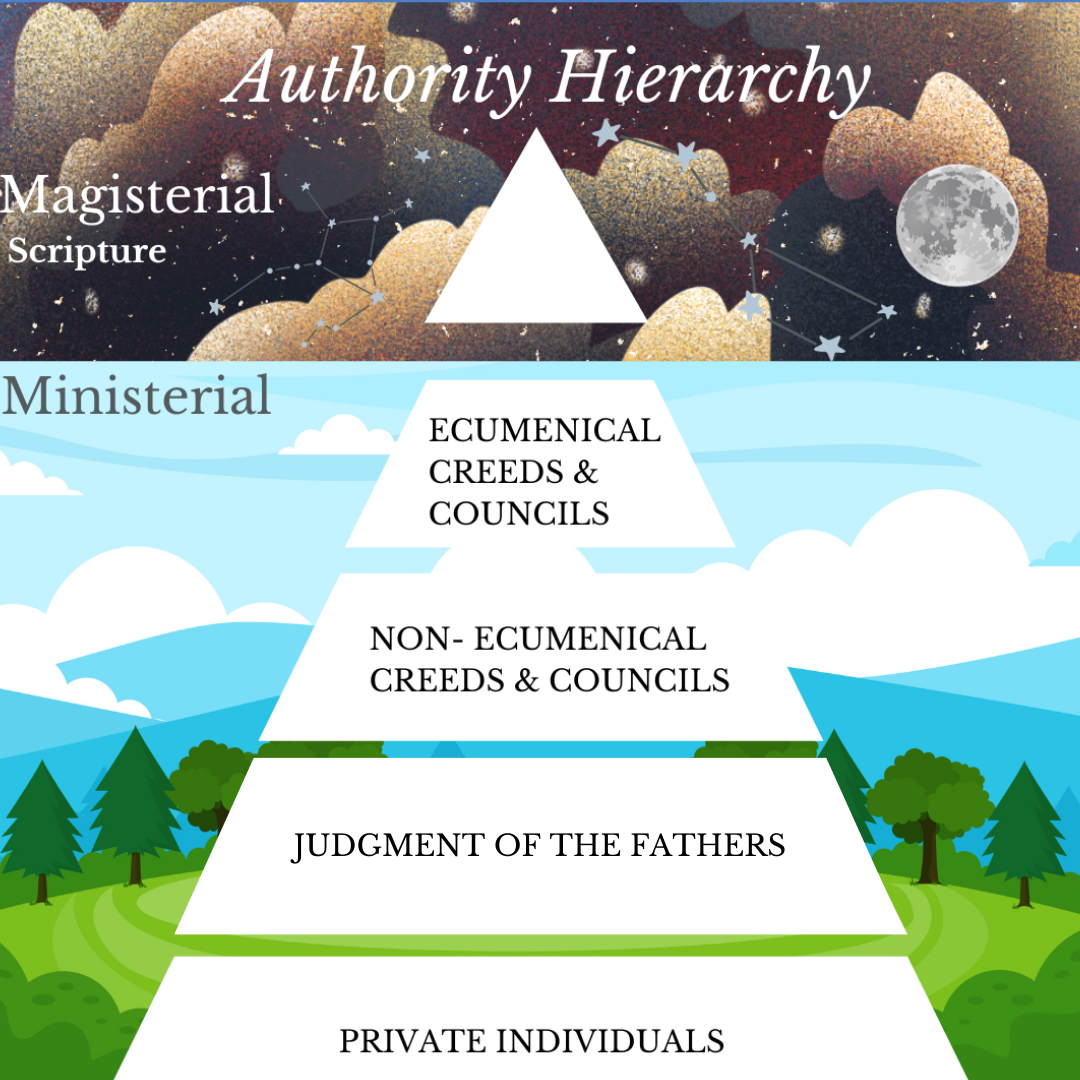
This hierarchy reflects the Reformed understanding of authority from Amandus Polanus’s perspective. The main detail is the background division between space and earth. I added this feature to Polanus’s model to illustrate that while authorities highly regard tradition, it does not belong in the same category as Scripture. Scripture’s authority resides in the heavenly realm because there is nothing beside it but the Lord. There is nothing that can be above it because it is infallible. Hence, we give it the proper title “supreme authority” because “supreme” is a superlative title that indicates an object that resides in its own category. As Aquinas states, it’s better to be called “super-hot” than it is to be called “hottest.” The latter merely indicates relative hotness within the same genus. The former indicates genus-transcending hotness.3
Likewise, this fact applies to sports rankings. When someone declares that Michael Jordan is the best of the best, they inform us that this figure cannot compare to the rest. Michael Jordan does not belong in conversations with LeBron because his game exists in a different realm.4 So, although other players can be great, they are not Michael Jordan. His game presides as the standard by which we measure one’s greatness in basketball. Thus, we call Scripture the supreme authority, and it possesses magisterial authority because it serves as the source of authority that grants authority to all created beings.
Conclusion
Scripture’s infallibility separates it from one of many authorities and sets it as THE authority. Therefore, the Bible does not eradicate other authorities but instead places them in their proper order. As the highest ministerial authority, ecumenical creeds like the Apostles’ Creed bind Christians to openly confess what is laid out in scripture with the historic church. Given that church tradition receives life from the Word, it cannot speak of its own and must echo the words of Holy Writ. Consequently, those who find themselves outside the confines of the ecumenical creeds find themselves outside of the Word of God, which would make them anti-Christ.”Those who demand a “biblical theology” are most often not as close to biblical teaching as is ecclesiastical orthodoxy with its extrabiblical terminology. This is also true for Christian doctrines other than the Trinity.”5
In denying creedal authority, modern evangelicals cut their connection to the historic Church, and become cave-men foreign to true doctrine. Side note: The judgment of the fathers includes ministers and individuals widely recognized for their contributions to the church. Non-ecumenical creeds is like the Westminster Standards. Private individuals would be layman like me.
NOTES
- Herman Bavinck, Reformed Dogmatics: Abridged in One Volume (Grand Rapids: Baker Publishing Group, 2011), 403 ↩︎
- William Cunningham, The Reformers and the Theology of the Reformation (Monergism Books, 2022), 35-36, https://web.archive.org/web/20240701062658/https://www.monergism.com/thethreshold/sdg/cunningham/The%20Reformers%20and%20the%20Theology%20-%20William%20Cunningham.pdf ; http://archive.today/pth83. ↩︎
- Thomas Aquinas, “Commentary on Dionysius’s On the Divine Names,” trans. Urban Hannon, The Aquinas Institute, accessed December 2, 2024, https://aquinas.cc/la/en/~DeDivNom, C4.L5.29. ↩︎
- It is important to point out that other athletes measure and define Jordan’s greatness. But with God, He doesn’t need anyone else to be great; He’s great all on His own. As the standard of greatness, the Lord doesn’t need anyone else to prove it; it’s just a natural part of who He is. ↩︎
- Herman Bavinck, Reformed Dogmatics: Abridged in One Volume, 403. ↩︎
BIBLIOGRAPHY
Aquinas, Thomas. “Commentary on Dionysius’s On the Divine Names.” Translated by Urban Hannon. The Aquinas Institute, n.d. https://aquinas.cc/la/en/~DeDivNom.
Aquinas, Thomas. Summa Theologiae. Translated by Fathers of the English Dominican Province. Www.newadvent.org. Second and Revised Edition. 1920. Reprint, Burns Oates & Washbourne, 2017. https://www.newadvent.org/summa/.
Bavinck, Herman. Reformed Dogmatics: Abridged in One Volume. Grand Rapids: Baker Publishing Group, 2011. Ebook.
Cunningham, William. The Reformers and the Theology of the Reformation. Monergism Books, 2022. eBook. https://web.archive.org/web/20240701062658/https://www.monergism.com/thethreshold/sdg/cunningham/The%20Reformers%20and%20the%20Theology%20-%20William%20Cunningham.pdf ; http://archive.today/pth83.
McGraw, Ryan . “Amandus Polanus on the Church’s Role in Interpreting Scripture (2).” Place for Truth, 2017. https://web.archive.org/web/20231231033530/https://www.placefortruth.org/blog/amandus-polanus-on-the-churchs-role-in-interpreting-scripture-2.